
SEO (Surface Electro-Optics), founded in 1998, is a developer and manufacturer of instruments for Surface Chemistry Analysis with a reputation for finesse in engineering and reliable high-quality service. NanoTechnology Solutions is the exclusive distributor of SEO’s instruments in Australia and New Zealand, offering installation, service, and technical support for a range of applications.

TCM-100
TCM-100 is an instrument developed by SEO for measuring the thermal conductivity of materials, an essential attribute in characterizing their capacity for conductive heat transfer. TCM-100 is ideally suited for quality control (QC) and R&D in lab-scale and industrial processes requiring measurements of thermal conductivity on a wide range of samples such as:
- Homogeneous materials in thin films, foils, graphite heat spreaders, and tapes.
- Sheets or thin board forms of materials like metals, polymers, rubber, plastic, ceramics, paper, textile, or wood
- Materials made of multiple layers where each layer can be detached and analyzed separately
Theory and working principle
Two types of measurements are possible in the TCM-100 instrument with upgraded options – vertical and horizontal type configurations.
Vertical bar type:
This measurement configuration in TCM-100 is based on the ASTM D5470 standard which is used to determine the thermal conductivity of a thin solid material by eliminating the effects of the specific test equipment utilized.
The sample is placed vertically between copper pillars at the top (cooling) and bottom (heating) until thermal equilibrium is attained. The temperature difference at the two interfaces is measured at a known steady heat flow through a known area with a known increasing thickness of material.
Three methods of measurement are possible:
- Measurement of samples of different thicknesses of the same material (2-measurement): The thermal conductivity is calculated by determining the inverse of the slope of the line produced by plotting the thermal resistance of the sample as a function of its thickness, using the formula in Figure 2. This is the standard method to get the most accurate value.
- Measurement of one sample of fixed thickness: In case two specimens of different thicknesses are not available for the same material, a copper reference is used to measure the interfacial thermal resistance value of each copper contact.
- Samples with multiple layers (3-measurement): SEO’s unique measurement method is suitable for analyzing the thermal conductivity of complex samples where each layer can be separated and the thermal resistance measured independently.
There are three modes of operation for different types of samples using the vertical method:
- Type Ⅰ: (Viscous sample)
- Type Ⅱ: (ViscoElastic solid)
- Type Ⅲ: (Elastic solid)
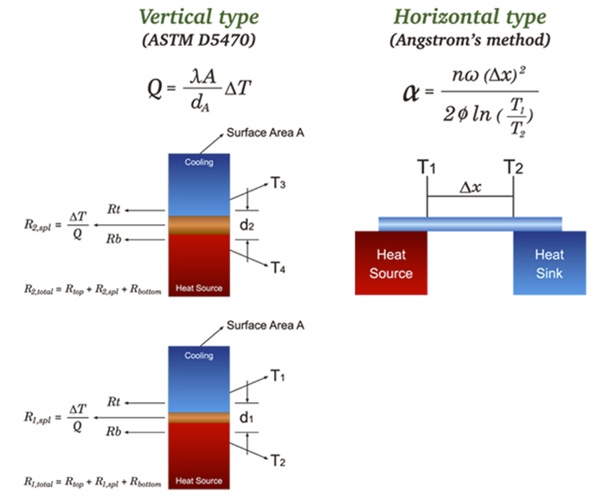
Horizontal bar type:
This configuration uses the Angstrom method which measures the temperature of two places located a certain distance from the heat source, obtains the thermal diffusivity, and multiplies the density of the material by the specific heat to obtain the final thermal conductivity, as given in Figure 2. It is suitable for certain thin samples and materials like graphite heat spreaders.

System features and benefits
The TCM-100 is factory-calibrated using specimens of known thermal resistance spanning the range of the instrument. The system does quick and easy operations on small sample sizes in short cycle times. It has the following benefits:
- Pressure control: Ability to apply pressure with precision from 0 – 500 psi using a compression rate control function with an internal crack confirmation function.
- Ultra-precise temperature control: The Peltier unit at the top records precise temperature data. Calculation of the applied power, based on accurate electrical parameters, is responsible for the high repeatability of the testing solution.
- A double protection cover to completely block the effect of surrounding airflow.
- Convenient equipment size with built-in coolant system: Optimised for the user’s convenience without a need for an external cooling system or control connections.
- Sample capabilities: A liquid-measuring copper jig can be used for viscous samples or specimens with adhesive strength.
- Automatic sample loading and temperature selection according to the type of measurement (I, II, or III)
- Automatic shut-off system to prevent dew formation caused by temperature difference.
- User-friendly Quantum-E software: Fool-proof application of concepts avoiding human errors in measurements and calculations. Convenient USB interface to laptop or PC.
- Real-time display with automatic calculation and provision of various quantities: Heat flow, sample thermal resistance, interfacial contact resistance, total thermal resistance, thermal conductivity, heat flux, graphs of thermal conductivity versus compression, etc.
- Function to maintain a constant temperature without natural cooling after completion of measurement.

Contact us for support and additional information regarding the product and applications.