
Electrospinning is one of the most effective and versatile technologies for producing nanofibres from a wide range of polymeric materials. Changing the effective parameters of the electrospinning process makes it possible to control fibre properties such as morphologies, orientations, structure compositions, homogeneity of distribution on membranes, etc. The simplicity of the fabrication scheme, the diversity of materials suitable for use, as well as the unique features of electrospun fibres with dimensions from sub-micron diameters down to nanometre sizes, make them attractive for a variety of applications such as healthcare, energy, catalysis, sensors, bio-engineering and environmental technology to name a few.
Inovenso specialises in the production of state-of-the-art electrospinning equipment to help companies achieve their goals in realising an economical approach to commercial-scale production. Currently, INOVENSO Co. is the leading manufacturer of nanofibre production equipment.
We offer a wide variety of electrospinning devices in three main categories as Laboratory Scale, Semi-Industrial, and Industrial Scale nanofibre production electrospinning equipment in Australia and New Zealand. As chosen by the University of Sydney, University of Queensland, UNSW, Deakin University, RMIT University, Swinburne University, Flinders University, Macquarie University, University of Newcastle, University of Wollongong, University of South Australia, University of Adelaide, University of Southern Queensland, and CSIRO amongst 600+ organisations globally. Contact us to discuss your electrospinning needs.
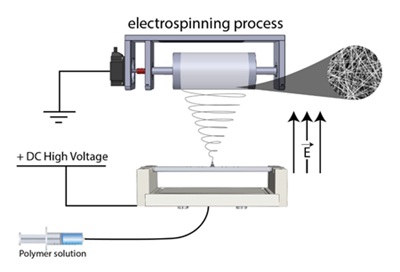
Components of Electrospinning Assembly
A simple electrospinning assembly consists of three distinct components:
- A feeding pump mechanism controls the flow of polymeric solution into the medium and nozzle at the end of the feed line (usually a syringe needle, although different feeding systems may be used).
- A grounded (or oppositely charged load) conductor collector.
- A high-voltage power source for generating a static electric field between the collector and the nozzle.

The driving force in the electrospinning process is the high potential difference of the static electric field between the droplet of the polymer solution and the collector. With this force, the spherical solution droplet elongates due to the accumulating charge on the surface of the drop and tends to form a conical shape, called a Taylor cone. When a critical voltage is reached, the electrostatic force becomes equal to the surface tension force, and a polymeric jet begins to form and travels towards the collector due to the charge repulsion.
The solvent evaporates during this motion, and a dry membrane structure is formed at the grounded collector assembly, where nanofibres form an electrospun mesh. The formation of a steady Taylor cone is an important indicator of a stable and continuous electrospinning process.
Effective Control of Process Parameters
The process optimisation necessary to obtain electrospun nanofibres of desired characteristics involves accurate control of three sets of parameters – solution properties, operation parameters, and environmental conditions.
Solution parameters
The morphology of electrospun nanofibres depends on the interplay of solution properties such as solvent selection, molecular weight of the polymeric material, viscosity, conductivity, and the surface tension of the solution.

- Polymer solution viscosity: The viscosity is the most critical factor in controlling the morphology of the nanofibres. Below a minimum value, beaded fibres or particles can be obtained. Increasing the viscosity of the solution increases polymer chain entanglements in the solution, leading to bead-on-string morphologies, i.e. electrospun fibres co-existing with particulates. After increasing viscosity above a maximum value, the surface tension becomes so high that jet formation becomes impossible. A specific level of solution viscosity is necessary to counteract the electrostatic forces and produce a uniform electrospun jet that leads to the collection of defect-free nanofibres.
- Solution conductivity: When the conductivity of the polymer solution is high, an enormous tensile force is created with respect to the applied voltage. This, in turn, helps in the formation of nanofibres with a significantly reduced diameter.
Electromechanical parameters
The morphology of the fibres and their distribution on the membranes depend on operating parameters such as the applied high voltage, flow/feed rate, and the distance between the tip of the spinneret and the collector, in the following ways:
- Applied voltage: Optimal voltage is necessary for obtaining defect-free nanofibres. Increasing the voltage reduces the drawing stress and hence decreases the fibre diameters. However, increased drawing stress can result in the breakage of fibres, making process maintenance highly challenging at high voltage.
- Flow rate: Higher flow rates will increase the production rate of the electrospinning process, but can have adverse effects on the morphology of the fibres if not properly controlled. The electrospinning system has to be designed for this purpose to obtain good fibres.
- Process distance: Nanofibre morphology is affected by the distance between the collector and the tip of the spinneret, because the distance is directly related to the deposition time, evaporation rate, and whipping or instability interval. Inovenso’s devices feature a fully automated, adjustable spinning distance.
Environmental conditions
The solidification process during fibre formation happens along with the evaporation of the solvent. The rate of evaporation and solidification both depend on the environmental conditions, such as relative humidity, temperature, or gas atmosphere. Therefore, controlling these conditions is key to producing nanofibres of desired characteristics consistently.
Needle-based and Needle-less Electrospinning Systems
High-efficiency production and throughput of uniform nanofibres through multiple jets are of great importance to the industrial applications of the electrospinning technique. Both multi-needle and needle-less electrospinning techniques come with multi-jet formation capability to enhance the productivity of conventional electrospinning processes.
- Needle-based systems use high-precision nozzles to avoid the beading effect after process optimisation. Nanofibres are produced conventionally with a low throughput and highly homogeneous morphology.
- Needle-less systems produce nanofibres at a higher throughput, albeit with higher dispersion of diameters. Beading effect occurs due to the open-surface process, but can be significantly reduced by optimising the parameters.
Hybrid Nozzle Technology

Conventional multi-needle electrospinning systems offer good process control, but they have a very limited production rate where one or two jets are formed from needles, producing small sample-size nanofibre scaffolds. Another disadvantage of the multi-nozzle system is repulsion by adjacent jets and the non-uniform electric field at each nozzle tip of the spinneret.
Inovenso’s Hybrid Nozzle Technology features specially designed nozzles with a reservoir area that maintains the form of droplets that exit the nozzle upon application of high voltage. This reservoir ensures precise control of the solution feed rate. It also allows the formation of multiple Taylor cones from a single droplet, enabling the production of multiple jets from one nozzle. This design increases the production rate by 3-4 times that of conventional needles, enabling much higher process efficiency without compromising the homogeneity of nanofibres.
- Innovative nozzle design: Our hybrid nozzles are engineered to handle a variety of polymer solutions and melts, ensuring versatile application across different industries, from medical textiles to advanced filtration systems.

Inovenso’s Hybrid nozzle with electrospinning spinneret (Inovenso, 2019) - Multi-nozzle electrospinning: Useful for producing composite fibres from polymers that cannot be dissolved in a common solvent. Specially designed to avoid interference between jets of adjacent nozzles.
- Compatibility and process variations: Inovenso’s hybrid nozzles are compatible with all syringe needles, offering flexibility and convenience for researchers and manufacturers. Using this needle-based setup, it is also possible to form fibres with a core and a shell (also known as coaxial fibres), or even multi-axial fibres with multiple cavities.

Click here to see a video of product NanoSpinner 24, which features all the advantages of the Hybrid Nozzle Technology.
Currently, we offer needle-based, hybrid, single-nozzle, and multi-nozzle electrospinning devices in three main categories as lab-scale, pilot-line, and industrial-scale nanofibre production electrospinning equipment in Australia and New Zealand.
Stream Spinner Technology
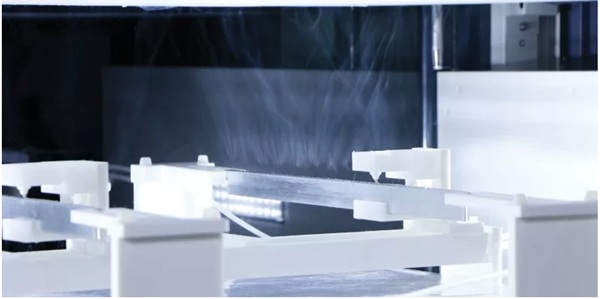
Conventional needle-less systems achieve higher throughputs with modified spinnerets, but the open surface solution feeding system can cause a significant obstacle in maintaining consistent solution concentration and viscosity, which affects the fibre morphology during production. It is also difficult to work with rapidly evaporating solvents using needle-less systems. The raw materials that can be utilised are limited, which in turn limits versatile fibre production.
Inovenso’s patent-pending Stream Spinner Technology is an open-surface electrospinning technology that offers superior control of process parameters at high production capacities, making it particularly suitable for industrial-scale production.

- Open-surface design: The solution is spread on top of a rod with a slit with no sharp focal point, unlike the orifice of a needle, for charge accumulation at a concentrated position. Thus, higher applied voltages are required for localising charge concentration throughout the surface of the solution.
- Control systems: A feeder periodically deposits the polymeric solution onto the rod with a slit, to which high voltage is applied to generate multiple jets (as shown in the image). The speed of the feeder header, feed frequency, and flow rate are controlled with a specialised interface designed by Inovenso.
- No clogging: The open-surface process avoids all issues associated with clogging of nozzles, such as material wastage and machine downtime.
- High production capacity: The open surface facilitates a smooth and continuous process, ideal for industrial-scale applications with a demand for producing large quantities of nanofibres.
- Desired fibre characteristics: The rotating spinneret, along with controlled feed mechanisms, enables the production of fibres with uniform alignment.
- Process variations: Stream Spinner is versatile and adaptable to different production environments, suitable for a wide range of industrial applications.
Click here to see a video of the features and functions of Stream Spinner devices.
Currently, we offer nozzle-less StreamSpinner electrospinning devices in semi-industrial and industrial-scale categories for nanofibre production electrospinning equipment in Australia and New Zealand.
Additional features and benefits
- Control of drum collector motion: The collector has a rotational degree of freedom to collect nanofibres of preferred orientations. Motion of the drum perpendicular to spray movement ensures a spatially homogeneous ‘coverage’ of fibres across the membrane from centre to edge.

- Customisable drum collector: Different products feature cylindrical or flat drums, or both options. The cylindrical drum’s diameter and length (even of the order of meters) can be customised for different applications. The membrane of the collector can also be customised (e.g., aluminium foil, nylon, etc.) as required.
- Fully-sealed chamber: Equipped with an internal extraction system connected to the lab exhaust system, which prevents leakage of toxic solvents into lab environments.
- Scale-up program: As customer needs evolve, plug-and-play modality makes it possible to smoothly transition from working with a small-scale device to an upgraded system without returning to the manufacturer or interrupting the workflow.
- Safe operation: Advanced safety regulations for the electro-spinning process, such as a safety-door option, over-current protection, spark protection, a safety-relay, and an emergency button.
- GUI Full-colour touch panel for easy operation and precise control of process parameters.
- Lifetime after-sales support.

Contact us to discuss your electrospinning needs and requirements.
