VitroTEM is a manufacturer of systems and tools for the fabrication and use of Graphene Liquid Cells (GLCs). Founded in 2019 in the Netherlands, their innovative technologies enable dynamic analysis of biological material and processes in liquid water at unprecedented resolution in standard electron microscopy systems. VitroTEM won the Microscopy Today Innovation Award in 2025 for the development of the Naiad GLC Fabrication System.
 NanoTechnology Solutions is the exclusive distributor of VitroTEM’s products in Australia and New Zealand, offering installation, service and technical support for a range of applications. Contact us to discuss your Electron Microscopy and Sample Preparation needs.

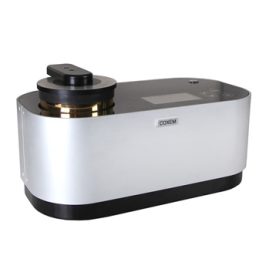
VitroTEM Naiad
The Naiad is VitroTEM’s benchtop device for automated GLC fabrication, making the use of GLCs easy and attainable for any laboratory by delivering the following features:
- Naiad fully automates the preparation and handling of graphene, delivering efficient, reliable sample production, so that researchers can focus entirely on sample imaging.
- GLCs assembled in 3 minutes
- Ultra pure single layer graphene
- Autoloader compatible
- Easy-to-use intefaces for complete assembly process.
- Naiad’s high-quality GLCs enable TEM imaging of whole biological cells and nanoparticles in liquid media, providing reliable and reproducible results for applications across biology, materials science, nanotechnology and so on.
- Samples on standard TEM grids
- Aqueous buffers or pure water
- Liquid Cell density – 10-100 per square micron
What are Graphene Liquid Cells (GLCs)?

LCs are sub-micron size pockets of water sealed between two layers of graphene. They have the following layered structure:
- A standard TEM grid with a porous polystyrene film covered with a monolayer graphene sheet acts as a base upon which a droplet containing the particles of interest is deposited.
- Subsequently, a second monolayer graphene sheet seals the droplet, encapsulating the liquid sample between the two graphene layers.
- This gives rise to a very stable pocket that is both water and vacuum tight. Typical GLCs have a thickness in the tens of nanometers up to 100 nm.
Advantages of Graphene
Graphene is an unrivalled substrate for TEM, offering:
- Optimal electron transparency: The ultra-thin pocket and graphene monolayers minimise electron beam scattering leading to remarkably high contrast and resolution, making it the most electron transparent window currently available for liquid-phase imaging of materials with low atomic numbers, such as biological samples and nanoparticles.
- Efficient charge dissipation: Graphene is highly conductive and a demonstrated radical scavenger, reducing unwanted effects like radiolysis, charging, or heating.
- Protection against beam damage: When GLCs are used as substrates for TEM, samples sustain significantly reduced harm from the electron beam irradiation.

Naiad Technology: VitroTEM’s procedural innovations
VitroTEM Graphene
VitroTEM aims to deliver ultra-clean GLC grids with highly crystalline monolayer graphene and full grid coverage. It achieves this through optimised in-house chemical vapour deposition growth of monolayer graphene on a copper substrate. Extensive analysis including Raman, transfer performance tests and cleanliness validation are performed on every batch.
- VitroTEM’s proprietary graphene is supplied on a small copper disk.
- The Naiad features a flow cell for the controlled etching of the copper disk preceding GLC assembly, which takes around 4.5h.
- After etching, the graphene floats freely on the surface of the liquid in the flow cell.
VitroTEM’s patented Loop Assisted Transfer (LAT) Technology
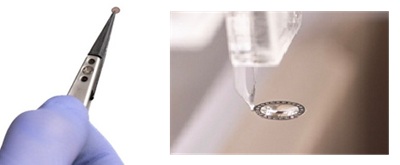
VitroTEM presents an automated, clean and reliable method for GLC fabrication called Loop-Assisted Transfer (LAT), ideally suited for assembling GLCs for high-resolution TEM imaging. The transfer process involves using a metal loop to transport both a pristine graphene sheet and a water droplet onto the TEM grid, resulting in minimal stress and a substantial coverage area of graphene in the liquid cells, ensuring that macro-scale continuity and mechanical stability are retained throughout process. VitroTEM provides disposable metal loops on a disposable cartridge that is mounted on the Naiad by hand. This technology has remarkable benefits:
- LAT does not require assistant polymer layers or post-processing steps, delivering ultra-clean graphene without any polymer traces.
- Graphene chips sent out to customers show a >99% success rate in full-coverage transfer to TEM grids in the Naiad system.
Graphene Spacer Technology
- Graphene is a robust material that can endure the extreme pressure difference between the ultra-high vacuum column of the microscope and the internal pressure within the GLC pocket.
- Furthermore, using VitroTEM’s patented spacer technology, the thickness of the liquid layer in the liquid cells can be easily controlled and optimised, usually found close to the sample dimensions.
- GLCs accommodate the sample without introducing deformations while offering the thinnest possible structure to minimise obstruction of the transmission electron beam.
- VitroTEM spacer technology greatly increases the density of liquid cells on the grid and the volume of individual liquid cells, while being highly reliable and reproducible.
Applications of VitroTEM GLCs
Liquid-Phase Electron Microscopy (LPEM)

VitroTEM brings GLC-technology as a standard tool for routine research in LPEM, enabling high-resolution imaging and systematic exploration of dynamic processes in aqueous samples. These analyses find use in a variety of applications such as the study of crystal nucleation and growth, corrosion, battery science, and organelles and proteins, due to the following benefits:
- Samples in GLCs are dissolved and hydrated, retaining many aspects of their native state, allowing scientists to better visualise samples in motion and study structural dynamics.
- The room temperature assembly process drastically simplifies the sample preparation compared to cryo-EM methods involving drying, freezing or fixating.
- The resulting ultra-thin structure leads to high resolution imaging of biological and organic matter with no need for staining.
- Unlike the use of specialised liquid cell holders for SiN chips, the GLC sample can be prepared on a conventional TEM grid and imaged using a conventional TEM holder. They are also thinner than SiN chips, resulting in much higher resolution.

Click here to view a testimony of Naiad’s excellent use for LPEM in life sciences.
Life Science analyses
- CLEM
- Tomography
- Low e-dose imaging
- Stained / unstained samples
- Buffer-filled GLCs
- Dynamic imaging
- Proteins & protein complexes
- EVs
- DNA, RNA
- Viruses
- Whole living cell processes
Materials Science analyses
- Low e-dose imaging
- Atomic resolution
- STEM
- HAADF
- Dynamic processes, formation, aggregation, degradation of:
- Electrode materials
- Nanoparticles
- Core-shell particles
- Tomography

Low Voltage Electron Microscopy (LVEM) with GLCs
In some applications observing sensitive organic samples and low atomic number specimens, compared to LPEM, a combination of LVEM and GLCs demonstrates advantages such as higher contrast, extended GLC longevity, and the elimination of staining requirements. Successful case studies include the imaging of ferritin and gold nanoparticles.
Radiolysis is a phenomenon critically observed in the context of liquid-phase electron microscopy. It occurs as the electron beam breaks up water molecules leading to the formation of H2 bubbles which move around within the cell due to diffusion, Brownian motion, etc., before eventually disappearing. The LVEM-GLC combination enables researchers to study the nucleation and growth of these bubbles, a task that is extremely difficult, if not impossible, using conventional high-voltage microscopes.

Specifications and Services
- GLC Kit: The GLC Kit supplies materials such as graphene, standard or special TEM grids, and loops for five GLC grids assembled in the Naiad system.
- Liquids pack: The Liquids Pack provides the fluids and buffers required for GLC assembly process in the Naiad.
- GLC fabrication service: Vitrotem offers GLC fabrication for your samples. The preparation can be performed within your own laboratory or at VitroTEM/partnering labs, depending on what your samples require. Contact us to find out how we can be of help with your in-vitro research.