
Laboratory-scale electrospinning devices are in demand worldwide as the scope for nanofibres in air filtration applications has expanded tremendously in the last decade. Currently, INOVENSO Co. is the leading manufacturer of nanofibre production equipment. We offer needle-based, hybrid, single-nozzle, and multi-nozzle electrospinning devices and their accessories as well as needle-less open-surface electrospinning devices. Contact us to discuss your electrospinning needs.

As chosen by the University of Sydney, University of Queensland, UNSW, Deakin University, RMIT University, Swinburne University, Flinders University, Macquarie University, University of Newcastle, University of Wollongong, University of South Australia, University of Adelaide, University of Southern Queensland, and CSIRO amongst 600+ organisations globally.
Nanofibres in Advanced Air Filtration Media
Air filtration systems are used in improving the air quality of media by capturing and filtering sub-micron particles such as fine dust, bacteria, and viruses. They have membranes which act as functional layers performing specific filtration actions in systems such as personal respirators, masks, vehicle cabin filters, heating, ventilation, and air conditioning (HVAC) systems.
Advanced research and production of Nanofibre media are essential to meeting the growing global demand for efficient air filtration systems, with the highest industrial demand concentrated in applications such as EPA, HEPA, and ULPA grade air filters, gas turbine, industrial dust collection, engine intake, and any customer-specified composites.
Key Advantages of Nanofibres
- Superior Filtration Performance
Nanofibre membranes possess the following advantages:- Sub-micron fibre diameters: Membranes are efficient at straining particulate matter (PM) of similar small sizes.
- High surface area to volume ratio: Enables production of light-weight active layers that provide numerous contact points for a high flux of particles in the air stream. Particularly makes it suitable for wearables.
- Controllable porosity of the membranes: Plays a huge role in the prevention of undesirable PMs of different kinds, such as dust, pollen, or even bacteria.
 SEM images of melt-blown microfibres and electrospun nanofibres. Source: Nanolayr
- Multiple Filtration Mechanisms
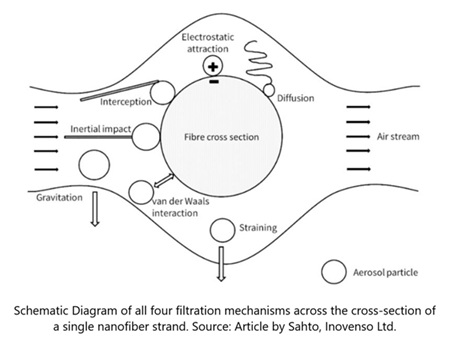
The four major mechanisms involved in air filtration are diffusion, inertial impact, interception, and electrostatic attraction. The functional layer of the filtration system can entrap PMs by mechanical capture as well as by electrostatic attraction enhanced by methods like corona-charging. By providing better filtration performance with a quite smaller weight per basis area, they outperform traditional media such as melt-blown microfibres and pultruded silica glass fibres.
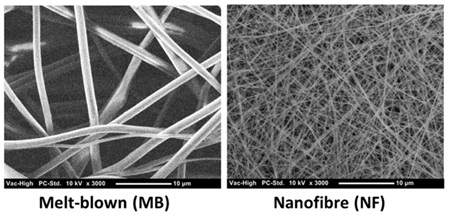 SEM images of melt-blown microfibres and electrospun nanofibres. Source: Nanolayr
Technical Features of Nanofibre Filters
- High Filtration Efficiency and Mechanical Performance
Nanofibre filters provide highly effective mechanical filtration due to their extremely small diameters. This results in:- High filtration efficiencies of 96% to 99% without reliance on electrostatic capture.
- Consistent performance, since charged layers tend to degrade over time and use.
- Maintains effectiveness even in humid environments (non-paper-based media doesn’t absorb moisture).
- Withstands exposure to sand and salt, disturbance of function, or deformation under mechanical stress.

- Step loading and Longer filter life
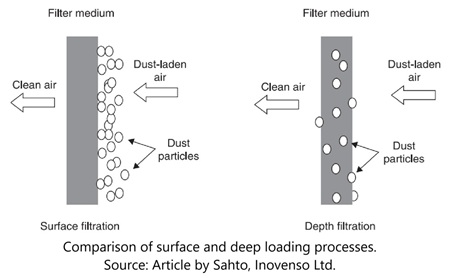
Unlike traditional filters that accumulate particles within the depth of the media (depth loading), nanofibre filters support surface loading with multiple benefits:- Contaminants accumulate on the outer layer and can be cleaned with backward air pulses or simple dusting.
- Filters remain functional for a longer time without significant pressure drop increases.
- Surface loading minimises energy demands over time and reduces the frequency of filter replacement.
- Low Pressure Drop & Better Breathability
Typically, there is a trade-off between filtration efficiency and air pressure drop, and high efficiency at low pressure drop is ideal. Slip flow caused by smaller fibre diameters reduces the momentum loss of air molecules, resulting in less resistance and lower pressure drop in the air stream. - Energy & Cost Efficiency
As a direct result of lower pressure drops and longer filter life:- Reduced resistance leads to more efficient airflow in HVAC systems, requiring less energy for ventilation.
- Low compressed air consumption in pulse-jet cleaning systems.
- Reduced need for frequent replacements or high-powered ventilation systems makes them cost-efficient in the long term.

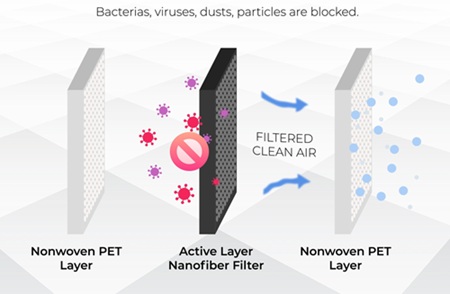
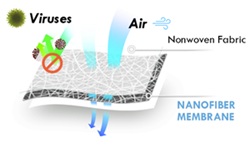
Schematic of Active Layer function in Nanofibre filter
- Customization & Functional Modifications
Electrospun nanofibre membranes can be engineered or post-treated to add specialised functionalities such as:- Antimicrobial and viricidal properties: Filters can include additives such as silver nanoparticles to prevent biocontaminants.
- VOC adsorption capabilities: Filters can be tuned for the removal of odours, gases and Volatile Organic Compounds (VOCs) similar to active carbon filters.
- Adjustable pore sizes: Filter configuration can be precisely controlled for diverse requirements and targets.
- Environmental Sustainability
Standard glass fibre filters are hard to recycle and dispose of. Nanofibre filters are a more sustainable choice because:- They can be made from biodegradable polymers, contributing greener HVAC and air filtration solutions.
- They reduce dependency on high-energy mechanical recycling or thermal incineration processes.
Inovenso’s Open Surface Electrospinning Technology
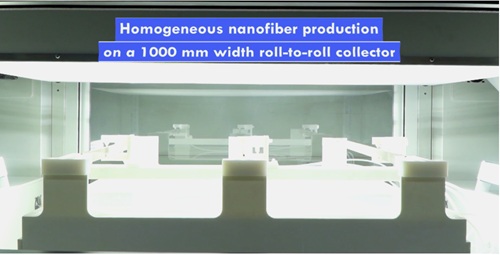
Inovenso’s patent-pending Open Surface Technology represents the most efficient and scalable approach to producing advanced nanofibre filters. It is a novel electrospinning method that enables high-throughput production of nanofibre meshes used in multiple applications. Its modular, customisable design allows machines to be tailored to specific applications, overcoming the production limitations of traditional systems and making it suitable for both product development and manufacturing plant setups targeting advanced filtration markets.
Stream Spinner Series – Unique Features
- Open Surface Split Spinnerets: U-shaped grooves eject multiple nanofibre jets, producing a uniform, homogeneous membrane layer.
- Plug-and-play design: Ensures operational ease and quick setup.
- Bottom-up spinning mechanism: Offers dynamic control via intelligent software and a single touchscreen panel.

- Flexible production: Enables the use of a wide range of polymers, including biodegradable materials, allowing for the production of environmentally friendly filters.
- Control of process parameters: High-voltage differentials (0 to 80 kV at the spinneret, -40 to 0 kV at the collector) to obtain nanofibres with the required properties.
- Advanced feeding systems: Flow rate control through smart peristaltic pumps.
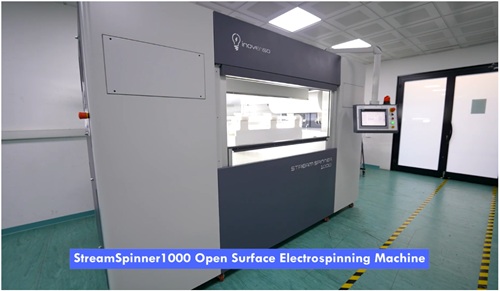
The Stream Spinner (SS) series — including the SS 300, SS 550, SS 1000, and SS 1600—enables the seamless transition from lab-scale research to high-throughput commercial-scale nanofibre production with minimum operator oversight. Nanofibres are deposited homogeneously onto non-woven substrates by a continuous roll-to-roll process, producing rolls of width from 550 mm to 1600 mm and lengths up to thousands of meters. The filtration membranes are produced in ready-to-ship rolled goods, making them commercially viable at scale.
Patented Hybrid Electrospinning System
Nanofibre media can also be created using Inovenso’s patented Hybrid Electrospinning technology, where fibre characteristics can be finely tuned by adjusting critical parameters to obtain nanofibres with controlled diameters and performance characteristics.
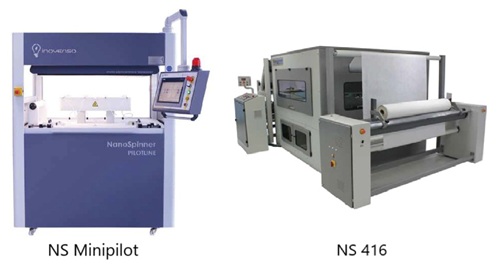
Electrospinning at an industrial scale is traditionally challenging, but Inovenso has overcome this with its multi-nozzle hybrid system. Each nozzle features a unique reservoir-base design offering production rates four times higher than standard needle-based systems. The nanofibres are collected on a non-woven substrate in a roll-to-roll system that can run in shifts.
The NS Pilotline devices PE 300 and PE 550 can be used to develop sample nanofibre membranes with large surface area coatings. This model is equipped with multi-nozzle feeding that enables round-the-clock high production rates of membranes. The parameters in this model can be changed while the instrument is running, providing flexibility in the process and reducing production time. NS 416 is another product for industrial-scale production of air filtration media, equipped with 204 electrospinning needles and a homogenisation system, allowing the 1-meter wide surface to be uniformly and continuously coated with nanofibres of diameters 50-400 nm.
Commercial Offers & Custom Services
Each company operates with unique goals and technical requirements to produce advanced air filtration media. In a world where HVAC systems, HEPA/ULPA filters, and air purifiers are in high demand, electrospun nanofibre-layered filters significantly enhance filtration efficiency and improve air quality. The following services are available to help customers reach their research and production goals:
- Full-service electrospinning technology support, aimed at accelerating clients’ projects with cost-efficiency and speed.
- End-to-end project support backed by 12 years of hands-on expertise in nanotechnology. For a full list of R&D services, click here.
A wide portfolio of nanofibre-based air filtration products produced by Inovenso’s own labs and team of engineers is also available. They meet local and international standards and benchmarks such as ISO 16890, ASHRAE 52.2, EN 1822/ ISO 29463, EN 143/149, and MERV classifications.
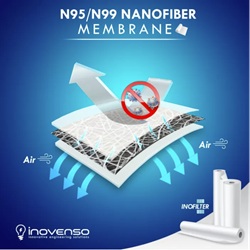
Inofilter 95/99 and Ino-V Filtration Masks
There is an increasing demand for air filter media for manufacturing reusable and disposable anti-pollution, anti-bacterial, and anti-viral face masks due to the rise in pollution levels and spread of airborne diseases all over the world.
The Inofilter 95/99 are nanofibre media blocking bacteria and viruses during inhalation and exhalation with filtration efficiencies of 95% and 99%. Developed by Inovenso using Hybrid Electrospinning technology, they have the following configuration:
- Outer layer: PET Spunbond, weight to area ratio 35 g/m2
- Inner layer (functional/active): Nanofibre mesh on polymer PVDF, weight to area ratio 0.6/0.8 g/m2
- Outer layer: PET Spunbond, weight to area ratio 35 g/m2
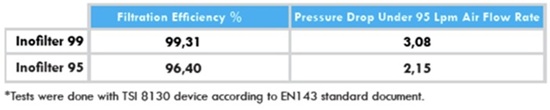
The Ino-V filter is also a nanofibre filter offering protection from airborne bacteria and viruses with a Viral Filtration Efficiency (VFE) of 99%. It has low breathing resistance and is resistant against liquids like blood, oil, etc. It is developed using Hybrid Electrospinning technology with the following configuration:
- Outer layer: PET Spunbond, weight to area ratio 30 g/m2
- Inner layer (functional/active): Nanofibre mesh on polymer PVDF, weight to area ratio 0.3/0.4 g/m2
- Outer layer: PET Spunbond, weight to area ratio 30 g/m2
These masks are lightweight, easily wearable, and comfortable to use. They can also be produced with different colours on demand, and with specific needs like hydrophobic, antibacterial properties.
With its patented systems, high-throughput capabilities, and flexible, customisable design, Inovenso’s Open Surface Technology represents the most efficient and scalable approach to producing and enabling the next generation of air filtration solutions.
Contact NTS for queries on products and technologies suitable for specific air filtration applications and requirements in both R&D and industrial-scale operations. We look forward to guiding you in the best way to realise your goals!