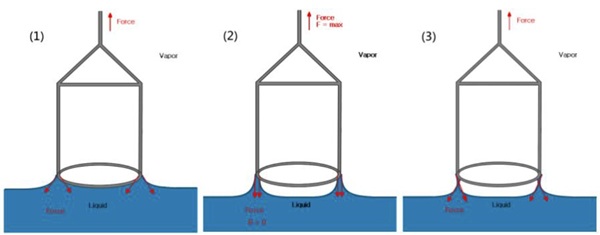
Interfacial tension measurements can be done using both the Ring and Plate Methods. The interfacial tension (𝛾) is calculated using the same equation as surface tension calculations:


Usually, the tension is measured between an aqueous liquid such as water, and a non-aqueous liquid such as oil. The interface between the liquids should be saturated in order to obtain accurate data.
When the density of both liquids is known, the interface tension can be measured using the Du Noüy ring technique by two methods:
Ring Pull Method
If the light-phase liquid is heavier than the heavy-phase liquid, use the Ring Pull Method in which the ring is immersed fully into the heavy-phase liquid and pulled up into the light-phase liquid, through the interface. Force measurements are done continuously.

Ring Push Method
If the heavy-phase liquid is heavier than the light-phase liquid, use the Ring Push Method in which the ring is immersed into the light-phase liquid and pushed into the light-phase liquid through the interface. Force measurements are done continuously.

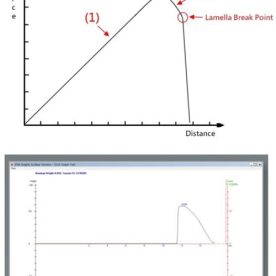
The Wilhelmy Plate technique can be used to measure the interfacial tension when the density of the liquids is unknown. The Zero Buoyancy procedure is the most commonly used method, and the measurement results are accurate. It is outlined in the diagram below:

Click here to access the DST series of analysers which offer interfacial tension measurements using the above methods.
Contact us for additional information on measurements and modalities for different surface chemistry analyses.