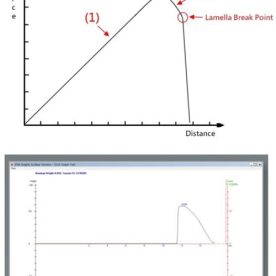
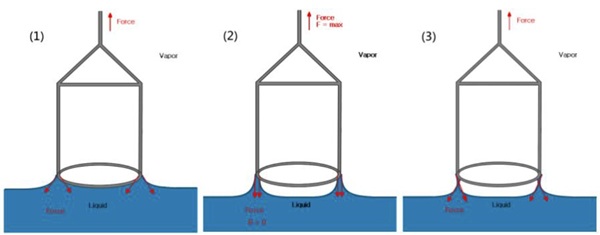
The DST series of analysers perform surface and interfacial tension measurements using the Wilhelmy Plate and Du Nuoy Ring methods. The DCA series of dynamic contact angle analysers are extremely sensitive instruments offering a wide range of measurements for surface characterisation such as:
- Dynamic Contact Angle
- Surface Tension
- Interfacial Tension
- Adsorption (Wicking)
- Powder Contact Angle
- Density/ Sedimentation/Penetration
- Zisman Plot (Critical Surface Tension) and Surface Energy
- Critical Micelle Concentration (CMC)
Dynamic Contact Angle
When a liquid comes into contact with a solid, it has a tendency to spread across the solid surface. The contact angle is a thermodynamic quantity that characterises the interaction between the solid and liquid at the liquid-solid-vapour contact point. Dynamic contact angle measurements can provide important insight into the nature of surfaces, surface reactivity, surface topography, homogeneity and porosity, and surface treatments required for bonding and adhesion.
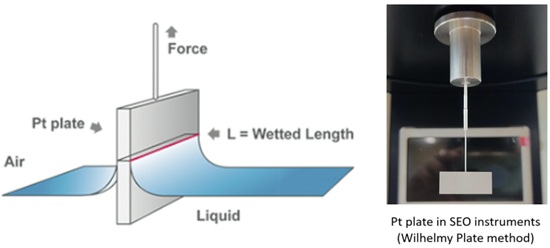
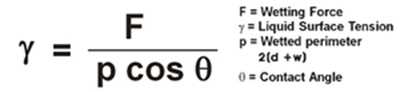
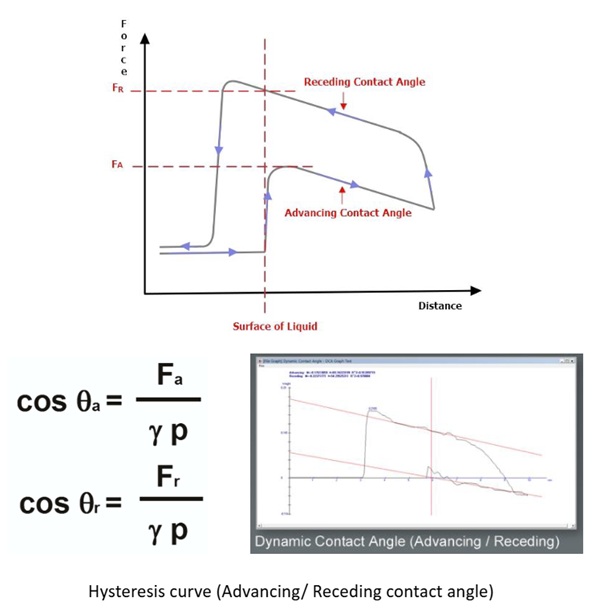
The Wilhelmy Plate technique can be used for dynamic contact angle measurements on non-porous solids that can be easily fashioned into flat plates, tubes, and rods (with identical coating on all sides and edges). The solid is immersed into the liquid and after equilibrium has been reached, the downward force exerted by the liquid on the solid is measured by an electrobalance. If the surface tension of the liquid and the wetted length (perimeter, if the plate has a thickness comparable to the length) on the solid surface are measured, the surface tension equation can be rearranged to determine the contact angle:
Advancing / Receding Contact Angle
For liquid moving quickly over a surface, the contact angle can be altered from its value at rest. The effect of dynamic processes can be studied by the Wilhelmy technique using the following procedure:
- The sample stage is raised and the solid sample, usually a flat plate, is dipped into the liquid until an ‘immersion depth’ is reached.
- During immersion, the downward force acting on the solid is measured continuously by an electrobalance. The contact angle of the liquid at the interface during this step is called the advancing contact angle.
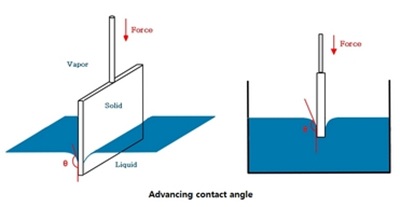
- When the immersion depth is reached, the system is allowed to reach equilibrium. Then the solid is pulled out of the liquid which causes the liquid to recede from the surface of the solid. The force on the solid and the receding contact angle are measured continuously during the process of removal.
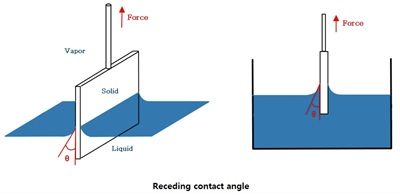
The plot of the force values during the full cycle produces a hysteresis curve. The hysteresis provides information on adsorption and dissolution behaviour, and surface homogeneity. The advancing contact angle will increase with the speed of insertion, and the receding contact angle will decrease with the speed of removal. The advancing contact angle can be used to calculate the surface free energy and the receding contact angle gives a measure of surface roughness.
Click here to access the DST series of analysers which offer dynamic contact angle and surface analysis measurements using the above methods.
Contact us for additional information on measurements and modalities for different surface chemistry analyses.