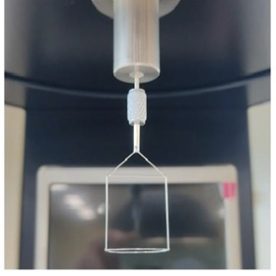
The two most common types of surface tension measurements are Ring (Du Noüy) and Plate (Wilhelmy) methods.
Du Noüy Ring method

- During measurement, a Platinum-Iridium ring is first dipped below the surface.
- The stage containing the beaker is slowly lowered and the force on the rising ring is measured by an electrobalance.
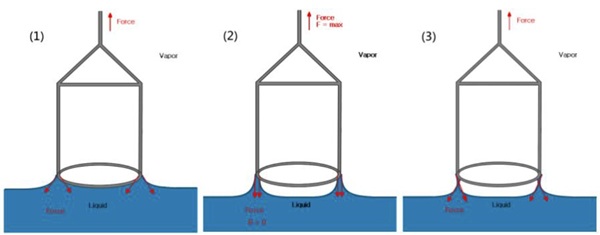
- When the ring reaches the surface, it stretches the free surface of the liquid, producing a lamella of area larger than the initial surface.
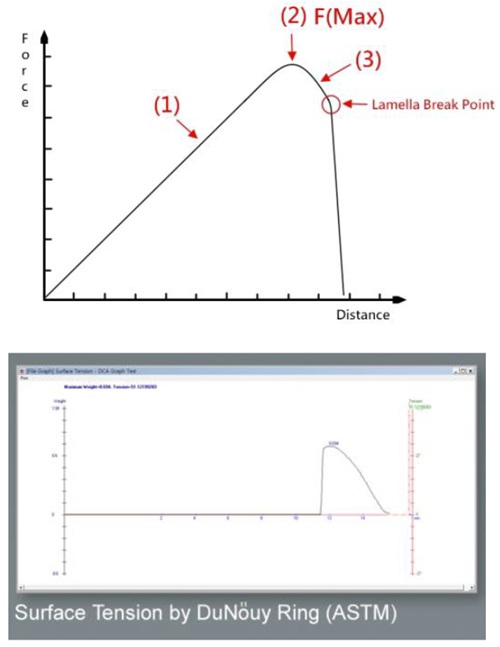
- Surface tension is a vector with magnitude and direction. It acts against both the outside and the inside of the ring. As the figure below illustrates, only a fraction of the total surface tension applies a force in the downward direction when the ring is slightly above the surface. As the stage is lowered, finally the force due to surface tension pulls straight down against the outside and inside of the ring. The force decreases slightly before the lamella breaks.
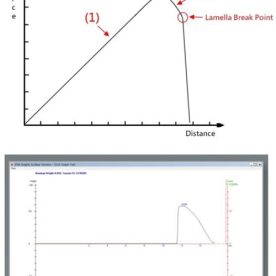
- If the force on the ring versus the height of the ring above the surface is plotted, it’s clear that a maximum pull and breakpoint is reached. This point is reproducible for pure liquids.
- Surface tension can be defined as:

Where 𝛾 is the raw surface tension calculated from the reading of the force measurement, and F is the correction factor, which is used to correct for the amount of liquid attached to the bottom of the ring during the pulling process of the experiment.


R: Mean of the ring radius, r: Mean of the wire radius,
D: Density of the Heavy phase, d: Density of the light phase.
D: Density of the Heavy phase, d: Density of the light phase.
Wilhelmy Plate method
- A probe with a small rectangle of solid (usually platinum) is used for the plate method of surface tension. The bottom edge of the plate is straight and parallel to the liquid surface. At equilibrium, the plate is suspended at the interface and maintained in this position by a force that balances the weight of the plate and the meniscus force of the liquid acting on the lower edge of the plate.
- The surface tension for the plate method can be defined as:

- The liquid’s contact angle with the plate is assumed to be zero, so no corrections for additional forces are required.
The Ring and Plate methods are suitable for different analyses due to the following differences:
- The Plate method provides a continuous reading of the surface tension, unlike the Ring method which continually stretches and compresses the surface to determine the maximum pull on the ring over time.
- Another major difference is how the measurement is carried out, i.e., the ring moves throughout whereas the plate is static. Any time-dependent effects observed are true effects of the surfaces and not the measurement procedure. Hence the Plate is the recommended geometry for studying time-dependent characteristics.
Click here to access the DST series of analysers which offer surface tension measurements using the above methods.
Contact us for additional information on measurements and modalities for different surface chemistry analyses.